Lesson 5 ·Class 10 · Sense Organs · Label Lab
Ear Structure and How We Hear
From the pinna to the organ of Corti, in order
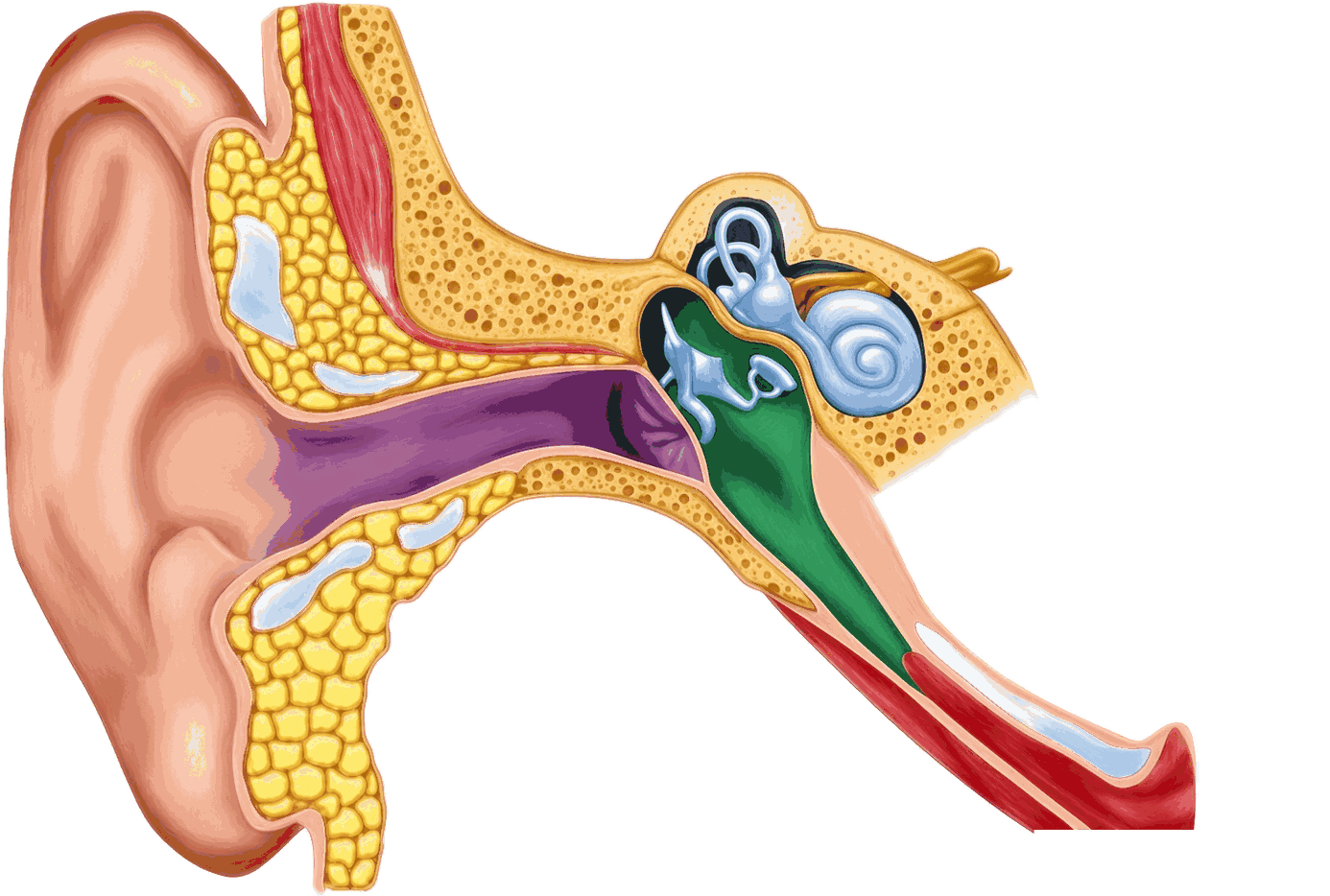
Tap any part of the diagram to learn its name and its job. Try: Say why three small ossicles are better than one single bone for hearing.
Free play — explore the diagram, or switch to "Label it yourself" and place every label. Switch to when you're ready to test yourself.
The ear drum and the ossicles only transmit and amplify — they do not detect sound. Detection happens in the organ of Corti inside the cochlea. Order to memorise: pinna, auditory canal, ear drum, malleus, incus, stapes, oval window, cochlea, auditory nerve.

What this lesson covers
What you do
- Say why three small ossicles are better than one single bone for hearing.
- Explain why your ears pop when a lift descends quickly, and which tube is responsible.
- Recall the range of frequencies our sensory endings detect: 20 to 20,000 hertz, most sensitive between 1000 and 4000 hertz.
The parts you label
- Pinna (auricle) — The projecting part of the outer ear. It collects the sound waves and directs them inwards.
- Auditory canal — The passage of the outer ear that conducts the collected sound waves to the ear drum.
- Ear drum (tympanum) — A membrane that is set into vibration by the arriving sound waves and passes that vibration on to the ossicles.
- Malleus — The first ear ossicle. The handle of the hammer is attached to the inner surface of the ear drum.
- Incus — The middle ossicle, joined to the hammer on one side and to the stirrup on the other.
- Stapes — The last ossicle. Its vibration is amplified by the lever-like action of the first two ossicles, and its flat part fits on the oval window.
- Oval window — A membrane-covered opening leading into the inner ear. The vibrating stirrup sets the fluid in the cochlear canals beyond it into vibration.
- Cochlea — The spiral snail-shaped part of the inner ear with two and a half turns. Its median canal holds endolymph and the organ of Corti, whose sensory cells lie on the basilar membrane.
- Auditory nerve — Carries impulses from the sensory cells of the cochlea, and from the balance organs, to the brain.
- Eustachian tube — Connects the cavity of the middle ear with the throat and equalises the air pressure on either side of the ear drum, allowing it to vibrate freely.
Challenges to clear
- Tap the tube that equalises air pressure so the ear drum can vibrate freely.
- Tap the ossicle whose flat part rests on the oval window.
- Place every label correctly on the ear.
Hint
The ear drum and the ossicles only transmit and amplify — they do not detect sound. Detection happens in the organ of Corti inside the cochlea. Order to memorise: pinna, auditory canal, ear drum, malleus, incus, stapes, oval window, cochlea, auditory nerve.