Lesson 1 ·Class 10 · Sense Organs · Label Lab
Receptors and the Eye's Protective Structures
Photoreceptors, phonoreceptors and the shield around the eyeball
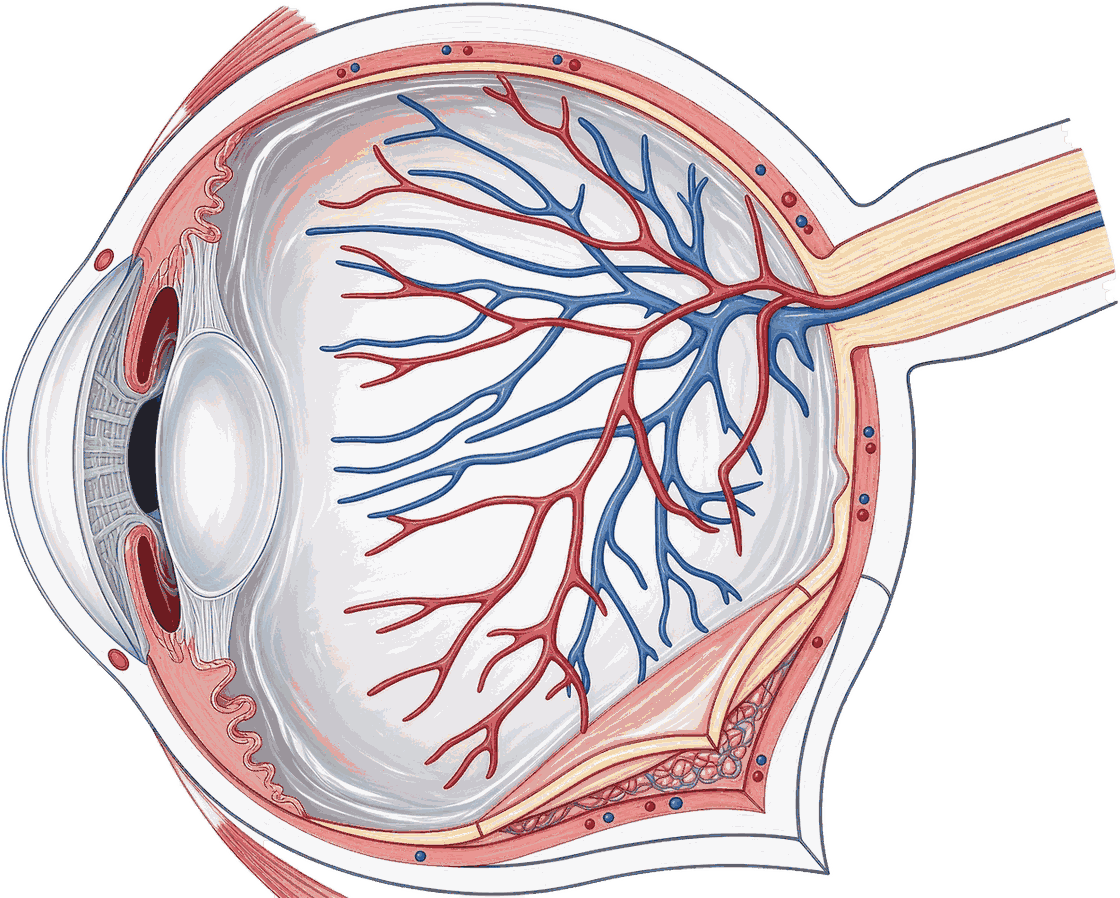
Tap any part of the diagram to learn its name and its job. Try: Shine a torch towards your eye while looking in a mirror and watch the pupil narrow.
Free play — explore the diagram, or switch to "Label it yourself" and place every label. Switch to when you're ready to test yourself.
Receptors are named after the stimulus they detect: photoreceptors (rods and cones) in the eye, phonoreceptors in the inner ear, chemoreceptors in tongue and nose, thermoreceptors and mechanoreceptors in the skin. Remember the iris controls the pupil, not the other way round.

What this lesson covers
What you do
- Shine a torch towards your eye while looking in a mirror and watch the pupil narrow.
- Name three protective structures that are not part of the eyeball itself: eyebrows, eyelids and tear glands.
- Trace the order in which light passes before reaching the lens: cornea, aqueous humour, pupil.
The parts you label
- Sclerotic layer (sclera) — The tough white fibrous outer coat of the eyeball. It gives the eye its shape and protects the delicate parts inside.
- Cornea — The front region of the sclera, where it bulges out and becomes transparent. Light enters here and its curvature begins converging the rays.
- Iris — The coloured extension of the choroid. Its radial muscles widen and its circular muscles constrict the pupil, so it regulates how much light enters.
- Pupil — The circular opening in the centre of the iris. It is dilated in dim light and constricted in bright light.
- Aqueous humour — The clear watery fluid filling the chamber between the cornea and the lens. It keeps the lens moist, protects it from physical shock and refracts light.
Challenges to clear
- Tap the part that acts like the diaphragm of a camera, adjusting how much light gets in.
- Tap the watery fluid that cushions the lens and helps refract the incoming light.
- Place every label correctly on the eye.
Hint
Receptors are named after the stimulus they detect: photoreceptors (rods and cones) in the eye, phonoreceptors in the inner ear, chemoreceptors in tongue and nose, thermoreceptors and mechanoreceptors in the skin. Remember the iris controls the pupil, not the other way round.