Lesson 3 ·Class 10 · The Reproductive System · Label Lab
The Female Reproductive System
Where the egg is made, met and settled
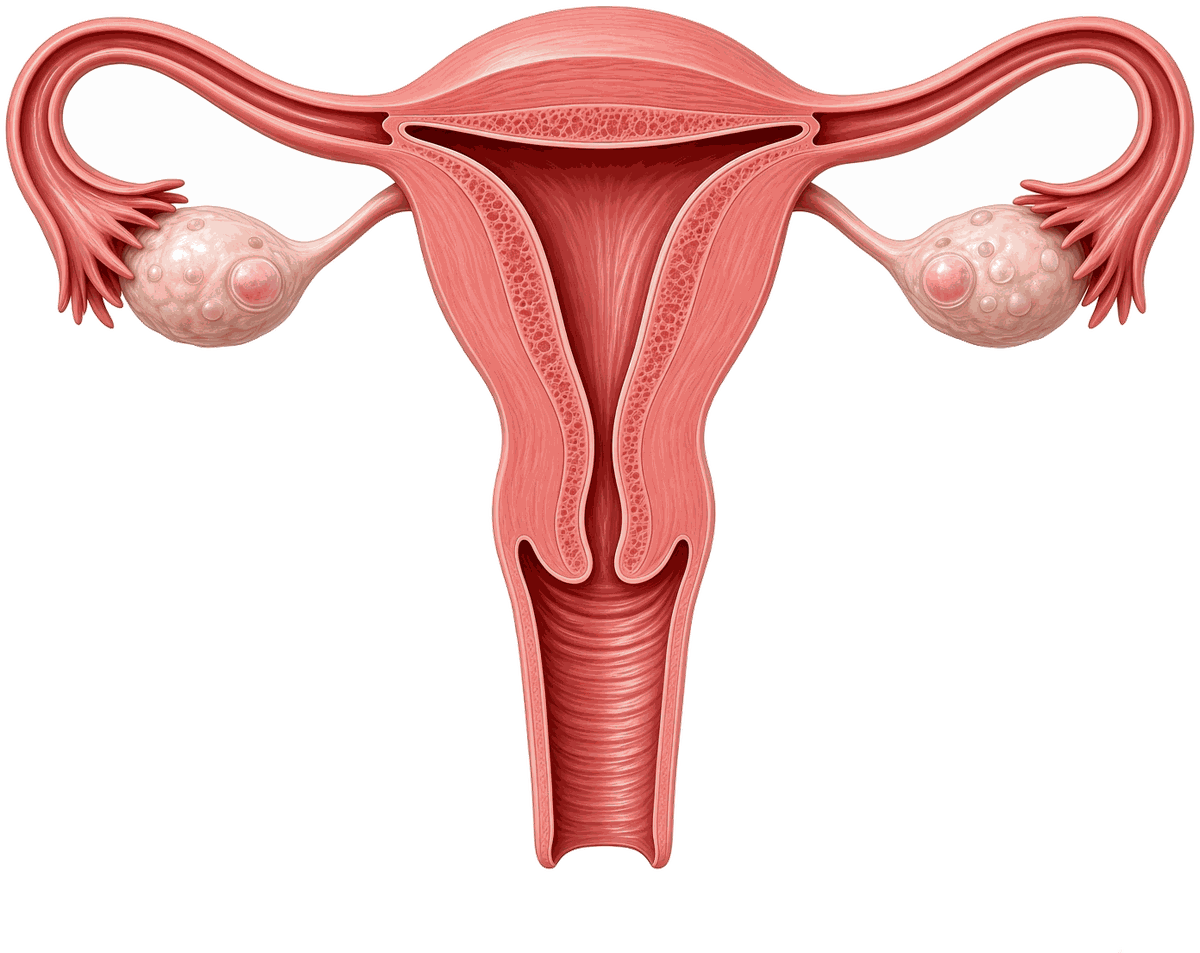
Tap any part of the diagram to learn its name and its job. Try: Only one egg matures in each ovary every alternate month. Work out how many eggs a woman releases in a year.
Free play — explore the diagram, or switch to "Label it yourself" and place every label. Switch to when you're ready to test yourself.
Fertilisation happens in the oviduct, not in the uterus. The uterus is where implantation happens. Examiners swap these two constantly.

What this lesson covers
What you do
- Only one egg matures in each ovary every alternate month. Work out how many eggs a woman releases in a year.
- The clitoris is the equivalent of the male penis, and the labia majora are the equivalent of the male scrotum.
The parts you label
- Ovary — A small ovoid body whose peripheral part produces the ova. A maturing egg sits in a follicle, which fills with fluid to become the Graafian follicle. The follicle secretes oestrogen; after ovulation its remnant becomes the corpus luteum, which secretes oestrogen and progesterone.
- Oviduct (Fallopian tube) — About 12 cm long. Its funnel is fringed with cilia called fimbrae, which pick up the released ovum. Peristalsis of the wall pushes the egg down towards the uterus. Fertilisation takes place here.
- Uterus — A hollow pear-shaped muscular organ, about 7 cm by 5 cm, sitting in the pelvic cavity between the urinary bladder and the rectum. Its upper wider part receives the two oviducts; the narrow lower part is the cervix. It protects and nourishes the growing embryo.
- Vagina — A muscular tube 10 to 15 cm long running from the lower end of the uterus to the outside. It receives the penis during copulation, and the great elasticity of its wall allows the baby to pass at childbirth. Its opening in young females is partially closed by a thin membrane, the hymen.
Challenges to clear
- Tap the organ where fertilisation takes place.
- Tap the organ that produces the ova and the hormones oestrogen and progesterone.
- Tap the organ in which the embryo implants and develops.
- Place every label correctly.
Hint
Fertilisation happens in the oviduct, not in the uterus. The uterus is where implantation happens. Examiners swap these two constantly.