Lesson 2 ·Class 10 · The Reproductive System · Label Lab
The Male Reproductive System
Where sperms are made and the road they travel
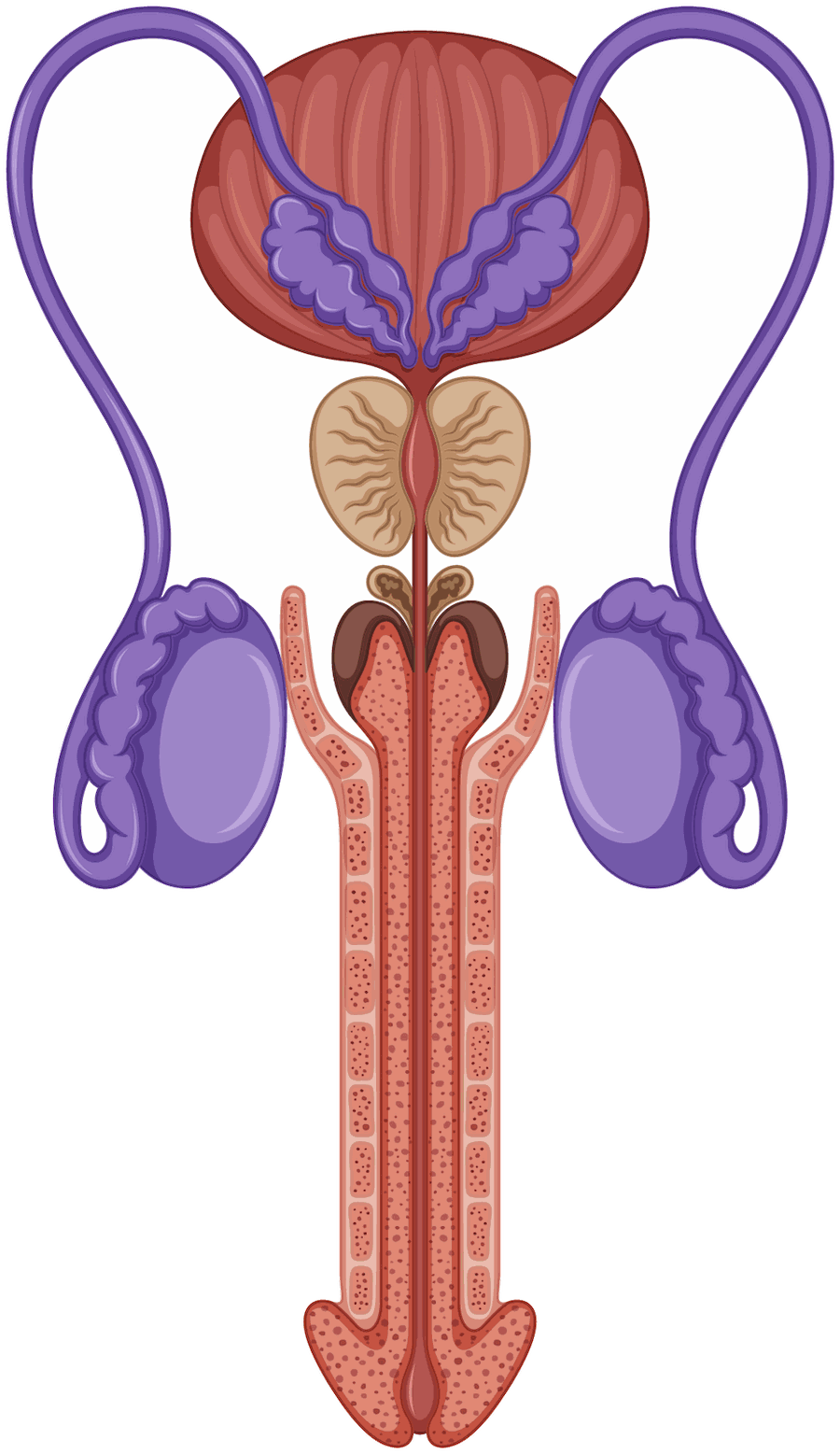
Tap any part of the diagram to learn its name and its job. Try: Trace the course of a sperm: seminiferous tubules, network of tubules, efferent ducts, epididymis, sperm duct, urethra.
Free play — explore the diagram, or switch to "Label it yourself" and place every label. Switch to when you're ready to test yourself.
Sperms are produced at a temperature 2 to 3 degrees Celsius below body temperature, which is why the testes hang outside the body in the scrotum.

What this lesson covers
What you do
- Trace the course of a sperm: seminiferous tubules, network of tubules, efferent ducts, epididymis, sperm duct, urethra.
- Name the three accessory glands and one function each: seminal vesicle, prostate gland and bulbo-urethral gland.
The parts you label
- Testis — One of a pair of oval organs held in the scrotum. Each is partitioned into about 250 lobules. Its seminiferous tubules produce sperms (spermatogenesis) and its interstitial or Leydig cells produce testosterone.
- Sperm duct (vas deferens) — Carries sperms upward from the epididymis through the inguinal canal into the abdomen. It loops over the ureter and joins the urethra behind the urinary bladder.
- Prostate gland — A bilobed gland surrounding the urethra close to its origin from the bladder. It pours an alkaline secretion into the semen, which neutralises the acid in the vagina.
- Urethra — The median duct contained inside the penis. It conveys the sperms received from the sperm ducts, and also carries urine, so it serves both systems.
Challenges to clear
- Tap the organ that produces both sperms and testosterone.
- Tap the gland whose alkaline secretion neutralises acid in the vagina.
- Tap the single duct that carries both semen and urine.
- Place every label correctly.
Hint
Sperms are produced at a temperature 2 to 3 degrees Celsius below body temperature, which is why the testes hang outside the body in the scrotum.