The Placenta — the Embryo's Lifeline
Two bloodstreams that come close but never mix
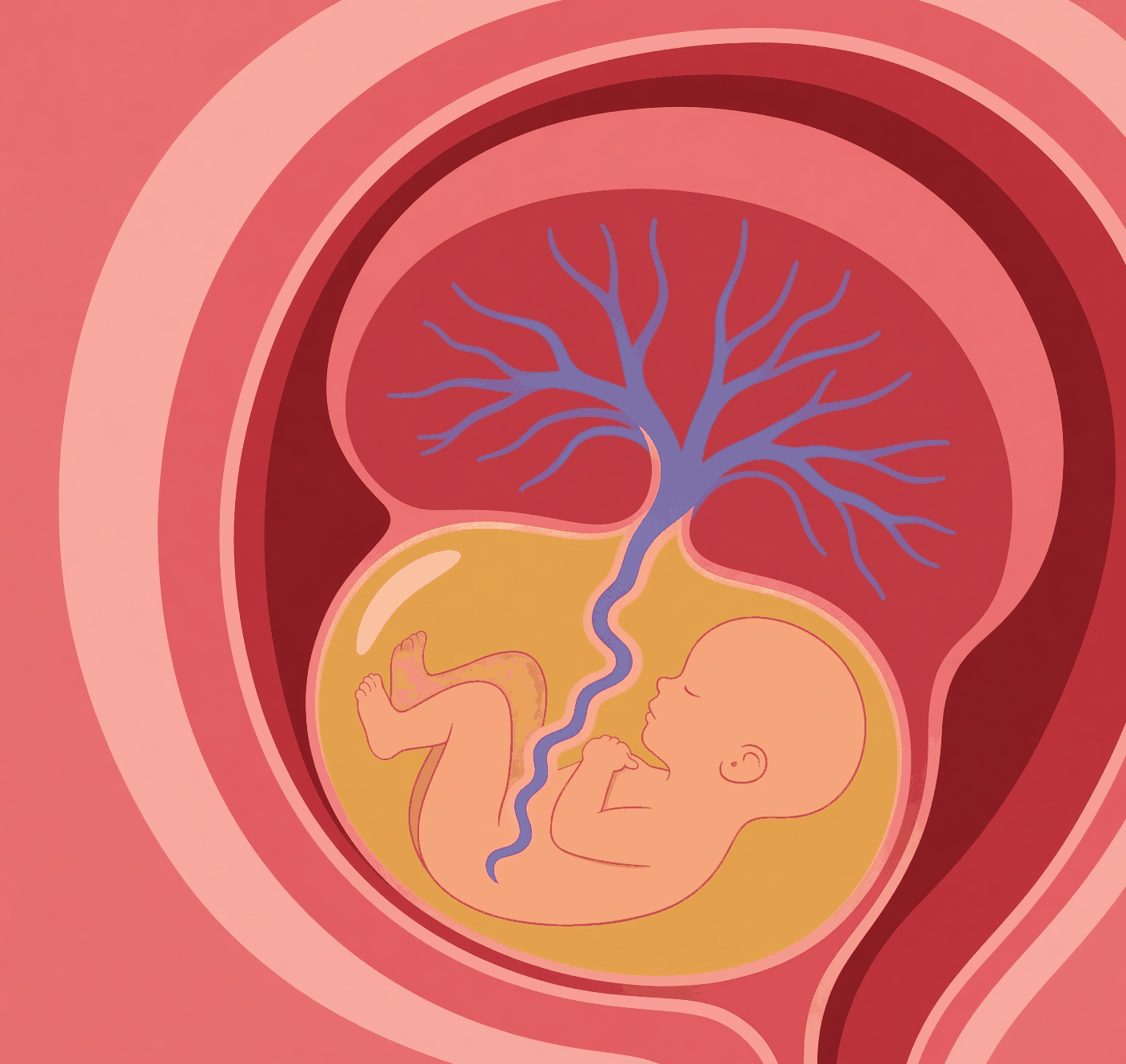
Tap any part of the diagram to learn its name and its job. Try: From Table 13.3, list what passes from mother to foetus: oxygen, glucose, amino acids, lipids and fatty acids, vitamins, mineral ions such as sodium, potassium, calcium and chlorine, certain drugs, alcohol, nicotine, antibodies and viruses. Going the other way: carbon dioxide, urea and other waste products.
Free play — explore the diagram, or switch to "Label it yourself" and place every label. Switch to when you're ready to test yourself.

What this lesson covers
What you do
- From Table 13.3, list what passes from mother to foetus: oxygen, glucose, amino acids, lipids and fatty acids, vitamins, mineral ions such as sodium, potassium, calcium and chlorine, certain drugs, alcohol, nicotine, antibodies and viruses. Going the other way: carbon dioxide, urea and other waste products.
- The placenta blocks germs, but the HIV of AIDS can cross it if the mother is already infected. About 15 minutes after birth the placenta itself breaks away and is expelled as the after-birth.
The parts you label
- Uterine wall — The muscular wall of the uterus. The placenta is attached to it as a disc, and one of the two sets of villi is given out by this wall. Its capillaries and blood sinuses carry the mother's blood.
- Placenta — A disc-like structure attached to the uterine wall. It is the intimate connection between the foetal membranes and the uterine wall, permitting nourishment to diffuse from the mother to the foetus and wastes to pass the other way. It also acts as an endocrine gland, producing oestrogens and progesterone.
- Chorionic villi — Minute finger-like projections. One set is given out by the uterine wall and the other by an extension from the embryo, the allantois. The two sets interlock closely but never open into each other.
- Umbilical vein — Carries blood back to the foetus with the oxygen, glucose, amino acids, lipids, vitamins and mineral ions that have diffused across the placenta from the mother.
- Umbilical cord — The cord containing blood vessels that connects the placenta with the foetus. Within a few minutes of birth its vessels shrink, and it can then be tied and cut.
- Umbilical artery — Brings foetal blood to the placenta. This blood contains the carbon dioxide and urea excreted by the foetus, and it flows through very fine placental capillaries lying close to the mother's capillaries.
- Amnion — An extraembryonic membrane that forms a sac around the embryo. It develops even before the allantois and is present right up to the time of birth.
- Amniotic fluid — Fills the space between the amnion and the embryo. It protects the embryo from jerks and mechanical shocks, keeps an even pressure all around it, allows some restricted movement and prevents the foetus from sticking to the amnion.
- Foetus — The developing young from about eight weeks, when limbs have appeared and it has a human-like appearance. It is a living organism: it needs food and oxygen, and it produces carbon dioxide and nitrogenous waste that must be removed continuously.
Challenges to clear
- Tap the disc-like structure that also acts as an endocrine gland.
- Tap the interlocking finger-like projections that never open into each other.
- Tap the vessel that carries carbon dioxide and urea away from the foetus.
- Tap the fluid that cushions the foetus against a fall.
- Place every label correctly.
Hint
The blood of the embryo comes in close contact with the blood of the mother but never mingles with it. If there were direct continuity, the relatively high pressure of the mother's blood would seriously damage the soft and delicate tissues of the foetus.