Lesson 3 ·Class 10 · The Excretory System · Label Lab
Blood Supply to the Nephron
Wide in, narrow out, pressure builds.
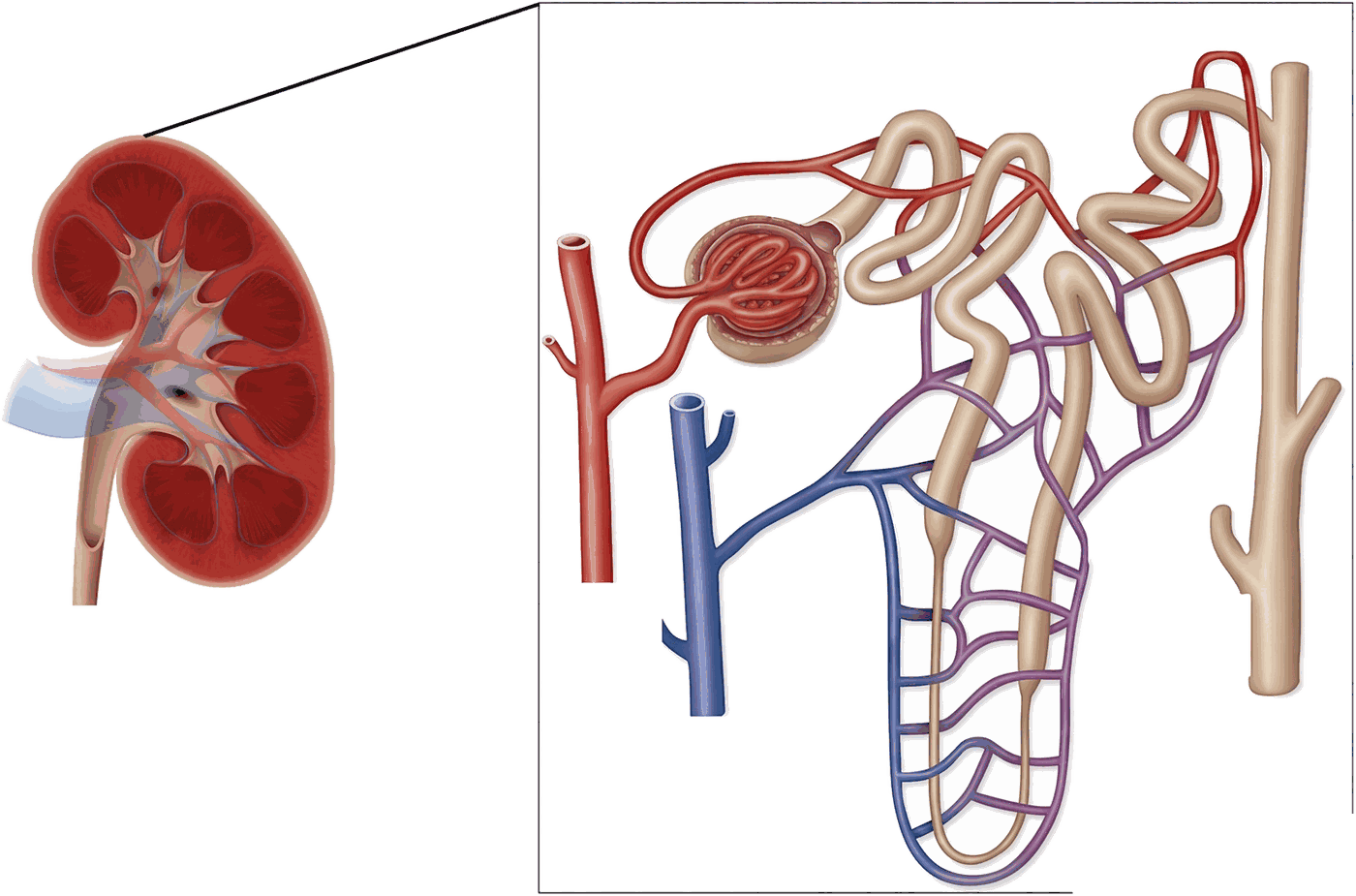
Tap any part of the diagram to learn its name and its job. Try: Corpuscles, proteins and other large molecules cannot filter out, so the blood leaving by the efferent arteriole is relatively thick.
Free play — explore the diagram, or switch to "Label it yourself" and place every label. Switch to when you're ready to test yourself.
Afferent is wide, efferent is narrow. That single difference in diameter builds the hydrostatic pressure that drives ultrafiltration. Swap them and filtration would stop.

What this lesson covers
What you do
- Corpuscles, proteins and other large molecules cannot filter out, so the blood leaving by the efferent arteriole is relatively thick.
- About 160 litres of glomerular filtrate form in 24 hours, yet only about 1.2 litres leave as urine. The capillaries around the tubule take back the rest.
The parts you label
- Afferent arteriole — A branch of the renal artery that brings blood into the Bowman's capsule. It has the larger diameter, and carries blood rich in water and nitrogenous wastes.
- Glomerulus — The capillary knot where blood flows under far greater pressure than in capillaries anywhere else in the body.
- Efferent arteriole — Formed by the reuniting capillaries of the glomerulus, it carries blood away. Its narrower diameter is exactly what raises the pressure inside the knot.
- Bowman's capsule — Catches the glomerular filtrate squeezed out under pressure: water, urea, salts, glucose and other plasma solutes.
- Peritubular capillaries — The secondary capillary network, also called the vasa recta, formed when the efferent arteriole breaks up again. It wraps the tubule and collects everything reabsorbed before rejoining to form the renal vein.
Challenges to clear
- Tap the vessel with the narrower diameter, the one that builds the pressure.
- Tap the network that takes back the reabsorbed water and glucose.
- Label the whole blood route through the nephron.
Hint
Afferent is wide, efferent is narrow. That single difference in diameter builds the hydrostatic pressure that drives ultrafiltration. Swap them and filtration would stop.